Pantry organization • Updated October 15, 2026
Choose pantry containers for your shelf and your shopping habits.
Start with the space you have and the foods you actually buy. A matching set can be useful, but the right sizes matter more than the number of pieces.
Affiliate disclosure: As an Amazon Associate I earn from qualifying purchases. The Amazon link below is a paid affiliate link; we may earn a commission at no added cost to you. This is researched buying guidance, not a hands-on test.
1. Measure the shelf before choosing the set
Record usable width, depth and height. Account for door hinges, shelf lips and anything that narrows the opening. Leave room to grip a container and lift or remove its lid; matching the outside height exactly is not enough.
Use the dimensions of each container in the chosen variant. A listing's overall package dimensions do not tell you whether every individual container will fit your shelf. If the individual measurements are unclear, check with the manufacturer before buying.
2. Match capacity to your normal refill
List the items you want to store, the package quantities you usually buy, and how much is normally left when you restock. Consider access for a scoop as well as the food itself. Follow the container's marked fill limit.
A food package's weight is not the same as a container's volume. Do not assume that a stated quart capacity guarantees room for a particular bag of flour, cereal or rice. Check ingredient-specific guidance for the exact container, or choose a larger suitable size after verifying the fit.
3. A set, individual containers, or no purchase?
4. One Amazon example: OXO five-piece POP set
Example listing • White five-piece set
OXO Good Grips POP Containers
The selected Amazon listing identifies five containers: one 2.3-quart, one 1.7-quart, two 1.1-quart and one 0.4-quart container. Verify the current variant and contents before ordering.
Why it might fit: you need a mix of smaller dry-storage capacities and have a use for each size. Why to skip: you mainly need large bulk-storage containers or would leave several pieces unused. The largest listed container here is 2.3 quarts; this is not the same assortment as a set containing a 4.4-quart container.
View five-piece example on Amazon (paid link)No current price, availability, star rating or performance guarantee is stated here. Check the seller, exact model and current terms on Amazon.
5. Check closure and cleaning requirements
Understand how the chosen lid opens, locks and comes apart for cleaning. Read the exact model's instructions for washing, drying and reassembly. Do not assume that instructions for a different color, generation or set apply to yours.
If a lid does not engage as instructed, check the maker's troubleshooting guidance rather than relying on a product photo or another shopper's experience. An airtight-storage claim is not automatically a promise of leak-proof transport, pest exclusion or a specific food shelf life.
Keep identification with the food
If you transfer food, retain the original product identity, date information and any instructions you need from its packaging. Keep a simple note of what is in each container so that similar-looking ingredients do not become a guessing game. Avoid adding more containers than you can readily identify and use.
Plan one shelf before buying a set
Copy or print this worksheet. Start with three foods you regularly buy. Check both the container's outside dimensions and its useful capacity; they answer different questions.
Shelf check: usable width ________; usable depth ________; clearance for lifting and opening ________. Write down the selected variant and where you verified individual dimensions: ________.
Why a capacity number alone is not enough
Illustrative volume example: if a refill occupies 1.6 litres and the remainder already occupies 0.3 litres, they total 1.9 litres before allowing for any needed headroom or scoop access. A nominal 1.7-litre container is too small for that amount. This example uses volume for both quantities; it does not convert a food's package weight into volume or describe the OXO set above.
A simple set-versus-single decision
- Consider a set when you can assign each included size to a real food and confirm its shelf position.
- Compare individual pieces when the set leaves sizes without a purpose or your usual refill needs a different capacity.
- Keep your current setup when it fits, remains identifiable and gives easy access. Reorganizing one shelf may solve the problem without a purchase.
Save the pantry-fit checklist
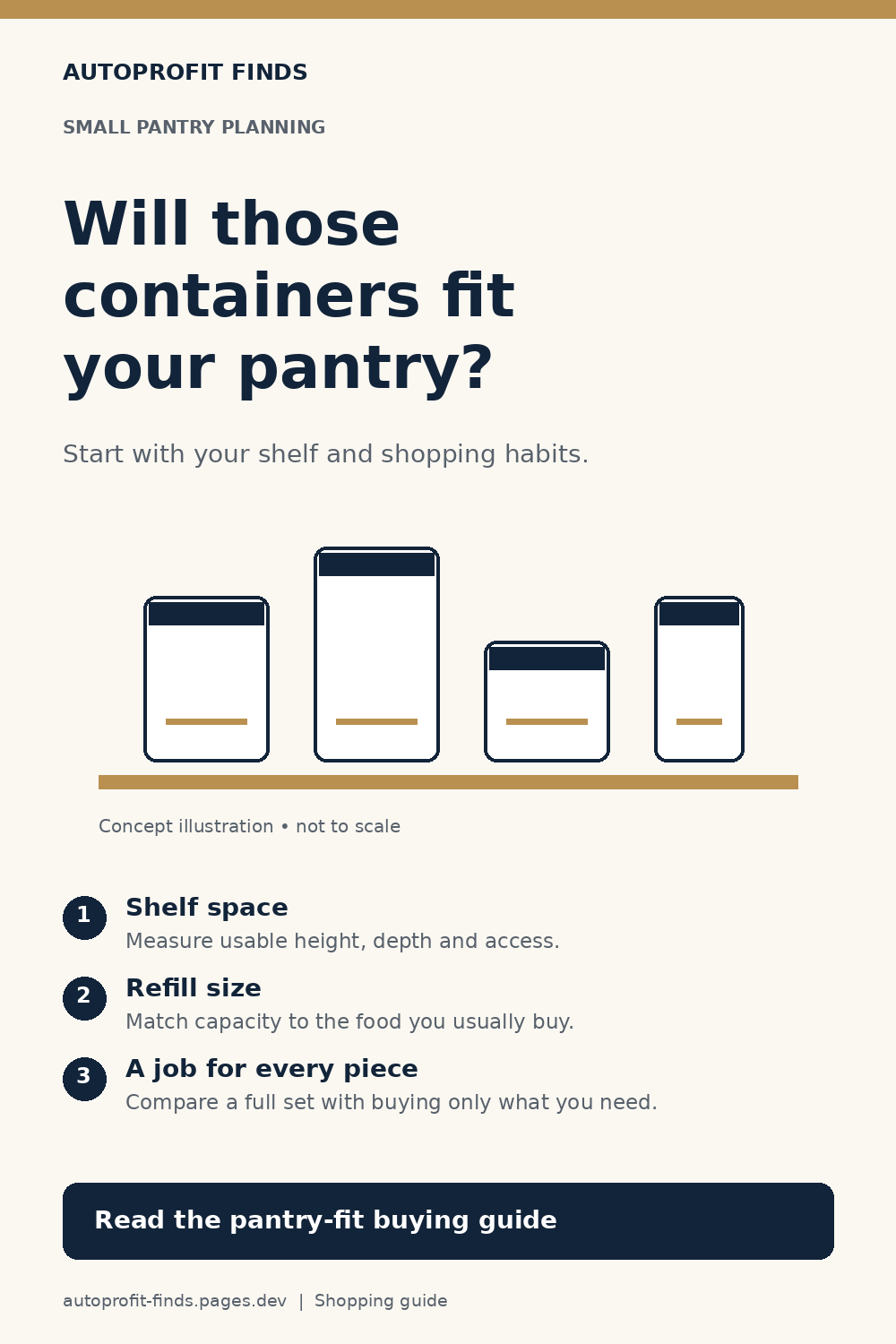
Save this checklist
Questions this guide helps you answer
- Will the set fit? Check individual container dimensions, opening clearance and access.
- Will my usual refill fit? Compare the actual food quantity with ingredient-specific capacity guidance; weight alone does not answer it.
- Do I need the whole set? Give every included size a job before buying.
- What about seals and cleaning? Follow the exact maker's instructions and inspect the closure rather than assuming every model works alike.
How this guide was prepared
We checked the selected Amazon listing, read eight displayed U.S. customer reviews, and consulted OXO product information. Reviews helped identify buying questions, not establish performance claims. They are a small selected sample and may reflect listing variations. This guide does not reproduce reviews, star ratings or customer endorsements.
The official OXO page we consulted displayed a matte-black variant, so its dimensions were not treated as specifications for the white Amazon example. No hands-on testing or scientific seal testing was performed.
OXO product reference • Product details checked October 15, 2026; they can change.
Read the kitchen drawer-fit guide or return to all finds.
